All content on this site is intended for healthcare professionals only. By acknowledging this message and accessing the information on this website you are confirming that you are a healthcare professional.
The PsOPsA Hub website uses a third-party service provided by Google that dynamically translates web content. Translations are machine generated, so may not be an exact or complete translation, and the PsOPsA Hub cannot guarantee the accuracy of translated content. The PsOPsA Hub and its employees will not be liable for any direct, indirect, or consequential damages (even if foreseeable) resulting from use of the Google Translate feature. For further support with Google Translate, visit Google Translate Help.


The PsOPsA Hub is an independent medical education platform. This activity is supported by an educational grant from Lilly. Funders are allowed no direct influence on our content.
Now you can support HCPs in making informed decisions for their patients
Your contribution helps us continuously deliver expertly curated content to HCPs worldwide. You will also have the opportunity to make a content suggestion for consideration and receive updates on the impact contributions are making to our content.
Find out more
Create an account to access:
Bookmark & personalize site content
Receive alerts for new content in your areas of interest
View psoriasis and psoriatic arthritis content recommended for you
Exploring the impact of obesity on psoriatic arthritis
 Laura Coates
 Jody Quinn
 Paolo Gisondi
 Yukari Okubo
Do you know... In patients with PsA and overweight/obesity, how does weight loss impact PsA disease activity?
During the PsOPsA Hub Steering Committee Meeting on August 24, 2026, key opinion leaders met to discuss the impact of obesity on psoriatic arthritis (PsA). The session opened with a presentation by Laura Coates and included a discussion featuring Paolo Gisondi, Jody Quinn, and Yukari Okubo. The discussion covered accessibility, long-term challenges, and patient experiences with weight loss interventions, and the importance of considering both psoriatic disease- and obesity-related comorbidities during treatment.
Discussion | Exploring the impact of obesity on psoriatic arthritis
Coates provides an overview of the impact of obesity on psoriatic disease, the current key data in favor of weight reduction as a therapeutic option for psoriatic disease, and a summary of the efficacy and safety data from the phase III TOGETHER-PsA (NCT06588296) trial.1
Studies have shown that increases in body mass index (BMI) correlate with a greater risk of developing both psoriasis (PsO) and PsA, and that patients with an elevated BMI experience greater levels of skin and joint disease activity (Figure 1).2-5 Subsequently, concomitant weight loss and pharmacological interventions for the management of psoriatic disease activity are of increasing interest.1
Figure 1. The impact of BMI on PsA skin and joint disease activity in the PsABio study*
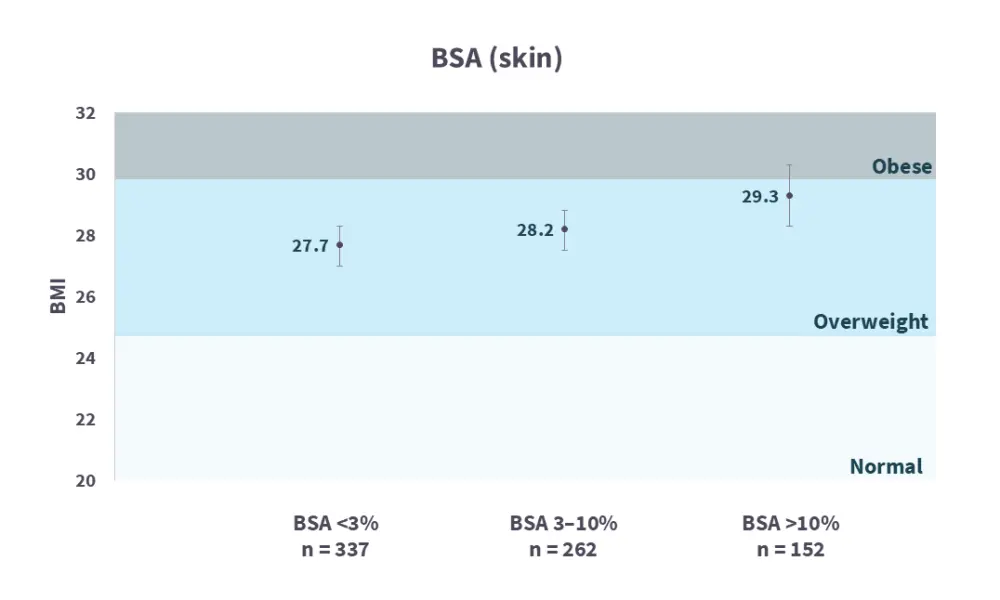
*Data from Siebert, et al.5
BMI, body mass index; BSA, body surface area; DAPSA, Disease Activity in Psoriatic Arthritis; HAD, high disease activity; LDA, low disease activity; MDA, moderate disease activity
Figure 1. The impact of BMI on PsA skin and joint disease activity in the PsABio study*
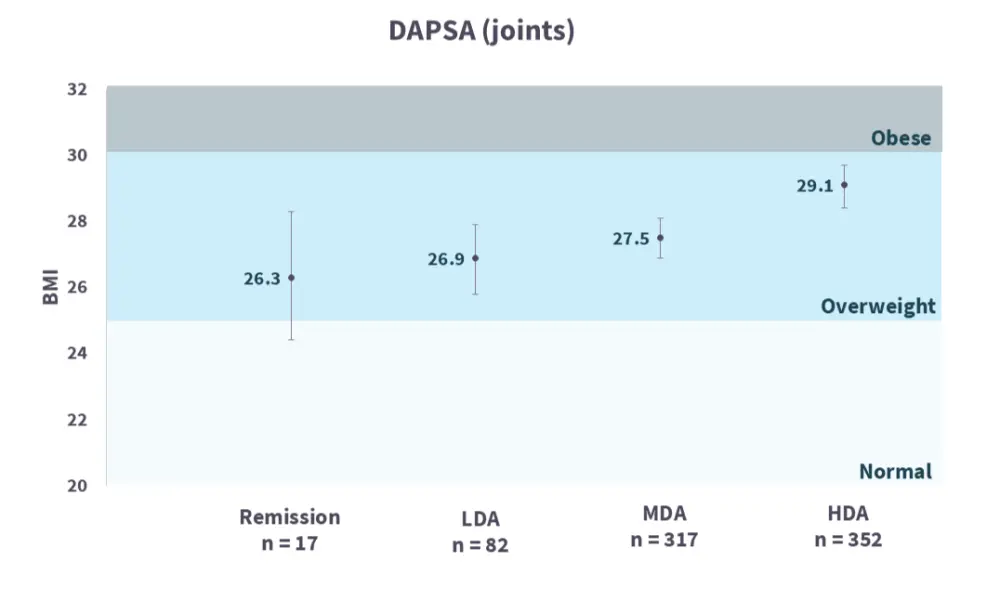
*Data from Siebert, et al.5
BMI, body mass index; BSA, body surface area; DAPSA, Disease Activity in Psoriatic Arthritis; HAD, high disease activity; LDA, low disease activity; MDA, moderate disease activity
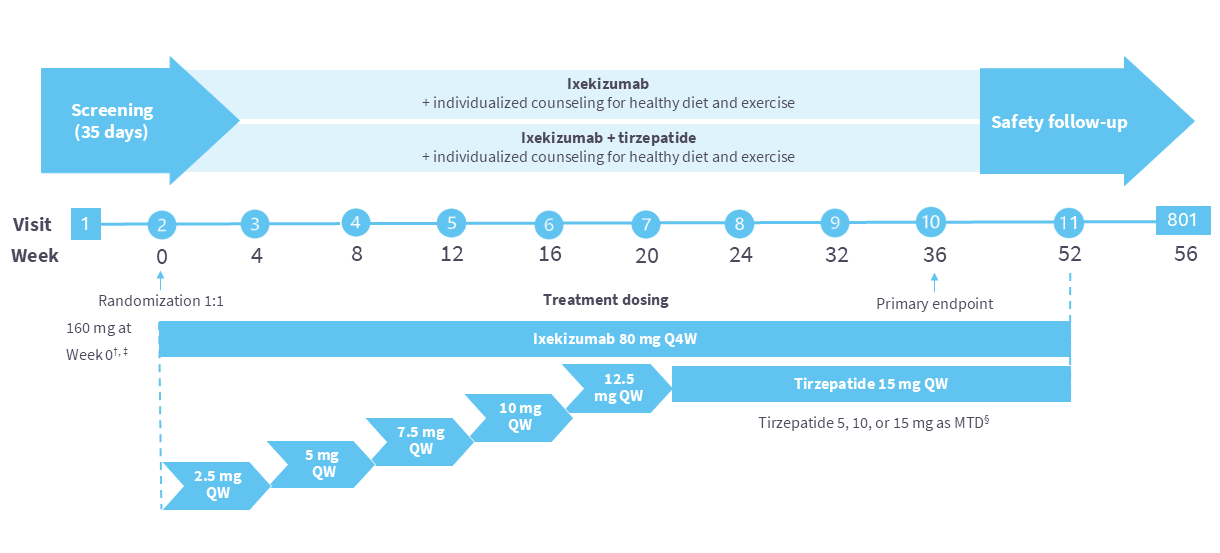
TOGETHER-PsA was conducted to evaluate ixekizumab + tirzepatide vs ixekizumab alone in patients with overweight/obesity and PsA.1 Patients were randomized to receive either ixekizumab + individualized counseling for healthy diet and exercise or ixekizumab + tirzepatide + individualized counseling for healthy diet and exercise (Figure 2).1 The primary endpoint was simultaneous achievement of ≥50% improvement in American College of Rheumatology response criteria (ACR50) and ≥10% weight loss at Week 36; key secondary endpoints included achievement of ACR50, ≥10% weight loss, and simultaneous achievement of ACR20 and ≥5% weight reduction.1
Figure 2. TOGETHER-PsA trial design*
Key points
- Obesity is a complex, multifactorial disease that is influenced by psychological, lifestyle and behavioral, environmental and social, and biological factors.6,7
- Studies indicate that obesity is associated with an increased prevalence of PsO, increased disease severity, and a greater risk of developing both PsO and PsA.2–5, 8–10
- Weight loss interventions, including dietary interventions, have been shown to improve disease activity in both PsO and PsA.11–14
- The European Alliance of Associations for Rheumatology (EULAR) and Group for Research and Assessment of Psoriasis and Psoriatic Arthritis (GRAPPA) recommendations for the treatment of PsA emphasize consideration and management of comorbidities, including obesity.15,16
- In the randomized, multicenter, open-label phase IIIb TOGETHER-PsA trial, a greater proportion of patients receiving ixekizumab + tirzepatide met the primary endpoint of simultaneous ACR50 and ≥10% weight loss at Week 36 vs ixekizumab alone (31.7% vs 0.8%; p < 0.001).1
- Significantly greater rates of ACR50 and percentage change in body weight were observed in the ixekizumab + tirzepatide vs ixekizumab alone group from Week 4 onwards.1
- A greater proportion of patients receiving ixekizumab + tirzepatide vs ixekizumab alone also met the secondary endpoints of ACR50 (33.5% vs 20.4% p < 0.05), ≥10% weight loss (84.5% vs 4.5%; p < 0.001), minimal disease activity (26.3% vs 15.3%; p < 0.05), ≥90% reduction from baseline in Psoriasis Area and Severity Index (PASI90; 52.2% vs 35.6%; p < 0.05), and Disease Activity in Psoriatic Arthritis (DAPSA) low disease activity/remission (39.9% vs 26.1%; p < 0.05).1
- The safety profile of ixekizumab + tirzepatide was consistent with the established profiles of the individual drugs, with no new safety concerns reported.1
- The most frequently reported adverse events (AEs) in the ixekizumab + tirzepatide group were nausea (29.7%), diarrhea (18.1%), constipation (16.7%), injection site reactions (15.2%), and vomiting (10.9%).1
- Gastrointestinal AEs were more frequent in the ixekizumab + tirzepatide group vs the ixekizumab alone group.1
- Together, the panel discussed the importance of individualized weight-loss interventions for psoriatic disease, emphasizing the importance of long-term consideration of treatment preferences, dietary and exercise education for both patient and physicians, and the effects of treatment on comorbidities.
This educational resource is independently supported by Lilly. All content is developed by SES in collaboration with an expert steering committee. Funders are allowed no influence.
References
Please indicate your level of agreement with the following statements:
The content was clear and easy to understand
The content addressed the learning objectives
The content was relevant to my practice
I will change my clinical practice as a result of this content
This content is accurate as of the date of publication and is not updated retrospectively. Please refer to the latest available evidence, guidelines, and relevant regulatory information when making clinical decisions.