All content on this site is intended for healthcare professionals only. By acknowledging this message and accessing the information on this website you are confirming that you are a healthcare professional.
The PsOPsA Hub website uses a third-party service provided by Google that dynamically translates web content. Translations are machine generated, so may not be an exact or complete translation, and the PsOPsA Hub cannot guarantee the accuracy of translated content. The PsOPsA Hub and its employees will not be liable for any direct, indirect, or consequential damages (even if foreseeable) resulting from use of the Google Translate feature. For further support with Google Translate, visit Google Translate Help.


The PsOPsA Hub is an independent medical education platform. This activity is supported by an educational grant from Lilly. Funders are allowed no direct influence on our content.
Now you can support HCPs in making informed decisions for their patients
Your contribution helps us continuously deliver expertly curated content to HCPs worldwide. You will also have the opportunity to make a content suggestion for consideration and receive updates on the impact contributions are making to our content.
Find out more
Create an account to access:
Bookmark & personalize site content
Receive alerts for new content in your areas of interest
View psoriasis and psoriatic arthritis content recommended for you
Apremilast in plaque psoriasis with limited skin involvement: Pooled results from six clinical trials
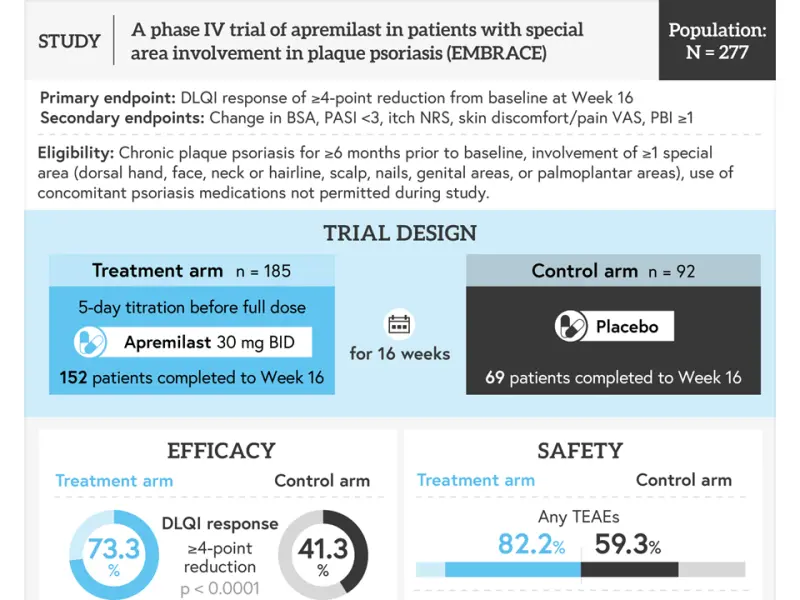
Results from a post hoc pooled analysis of the ADVANCE (NCT03721172), DISCREET (NCT03777436), STYLE (NCT03123471), EMBRACE (NCT03774875), UNVEIL (NCT02425826), and PROMINENT (NCT03930186) trials evaluating the efficacy of apremilast in patients with plaque psoriasis and limited skin involvement (affected body surface area [BSA], 3–10%), including those with high-impact site (HIS) involvement of the scalp, genital, and/or nails, were published in Dermatology and Therapy by Strober et al. Patients received oral apremilast 30 mg twice daily (BID) or placebo for 16 weeks, followed by open-label apremilast 30 mg BID through Week 32 (ADVANCE, DISCREET, and STYLE) or Week 52 (EMBRACE and UNVEIL); patients received apremilast 30 mg BID through Week 32 in PROMINENT. Overall endpoints included the proportions of patients achieving BSA ≤3%, a Psoriasis Area and Severity Index (PASI) score <3, a static Physician’s Global Assessment (sPGA) score of 0/1, and a Dermatology Life Quality Index (DLQI) score of 0/1 at Weeks 16 and 32. Site-specific disease activity measures were also assessed at Weeks 16 and 32.
Key data: At Week 16, a greater proportion of patients receiving apremilast (n = 671) vs placebo (n = 481) attained BSA ≤3% (adjusted treatment difference [aTD], 25.1; 95% confidence interval [CI], 19.7–30.6), PASI <3 (aTD, 23.0; 95% CI, 17.0–28.9), sPGA 0/1 (aTD, 17.9; 95% CI, 13.2–22.5), and DLQI 0/1 (25.8% vs 8.1%; all p < 0.0001). At Week 16, apremilast vs placebo demonstrated higher rates of Scalp Physician’s Global Assessment (ScPGA) 0/1 in patients with scalp involvement (aTD, 22.5; 95% CI, 15.5–29.6; p < 0.0001) and sPGA of Genitalia (sPGA-G) 0/1 in patients with genital involvement (aTD, 20.3; 95% CI, 9.2–31.4; p < 0.001), as well as a greater reduction in Nail Psoriasis Severity Index (NAPSI) score in patients with nail involvement (aTD, −24.3; 95% CI, −37.2 to −11.4; p < 0.001). Responses were generally maintained through Week 32.
Key learning: In this pooled analysis, apremilast demonstrated significant improvements in skin clearance and quality of life (QoL) vs placebo, with responses generally maintained through Week 32 in patients with plaque psoriasis and limited skin involvement, including those with scalp, genital area, and/or nail involvement. These findings support apremilast as a systemic treatment option for this patient population.
References
- Strober B, Lebwohl M, van de Kerkhof P, et al. Efficacy of apremilast in patients with psoriasis with limited skin involvement, including high-impact site involvement: A pooled analysis of six trials. Dermatol Ther (Heidelb). 2026;16:5839-5853. DOI: 10.1007/s13555-026-01921-9
Please indicate your level of agreement with the following statements:
The content was clear and easy to understand
The content addressed the learning objectives
The content was relevant to my practice
I will change my clinical practice as a result of this content
This content is accurate as of the date of publication and is not updated retrospectively. Please refer to the latest available evidence, guidelines, and relevant regulatory information when making clinical decisions.